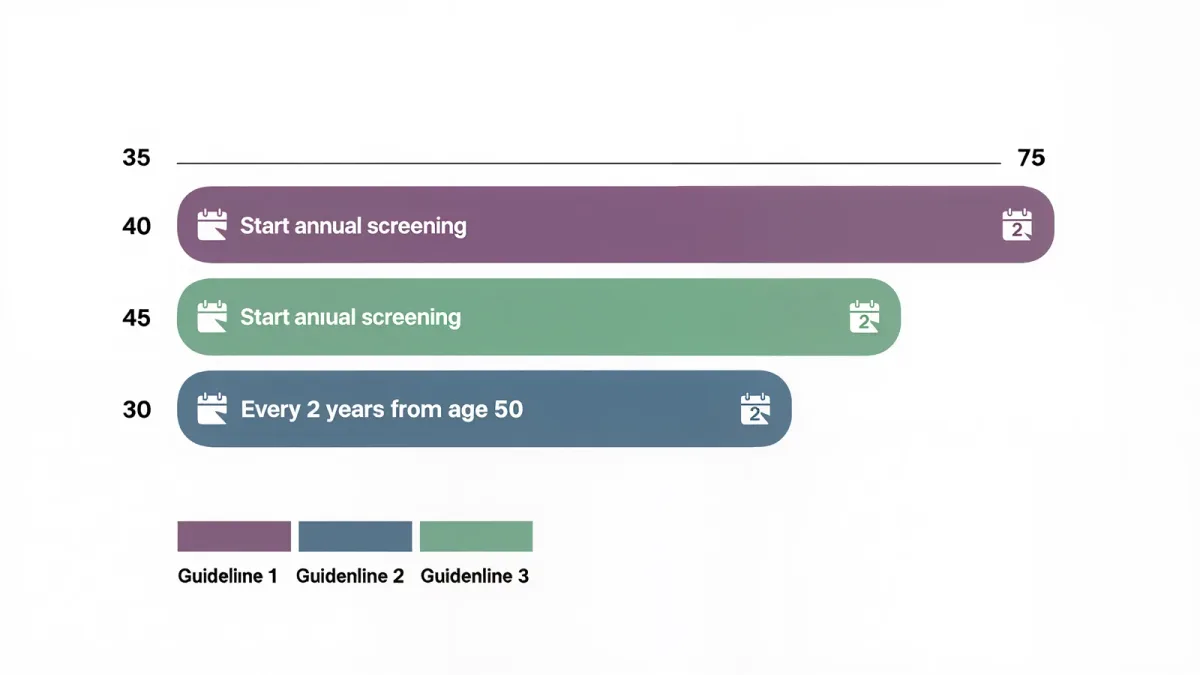
For women at average risk of breast cancer, the US Preventive Services Task Force's 2024 final recommendation calls for a screening mammogram every two years between ages 40 and 74 — a change from its 2016 advice, which started routine screening at 50. The American Cancer Society sets the bar slightly differently: annual screening from ages 45 to 54, with the option to begin at 40, then switching to every two years from 55 onward, per its 2015 guideline. The reason for the 2024 shift was concern about rising breast cancer diagnoses in women in their 40s, per the task force's published rationale — and the remaining disagreement between guidelines is about how to balance earlier detection against false positives and overtreatment.
Screening decisions for women with higher-than-average risk — a strong family history, genetic mutations, or prior chest radiation — follow a different, earlier schedule set by a clinician.
What exactly did the 2024 USPSTF change?
Two things: the starting age and the rationale behind it. The 2024 final recommendation moved the routine start from 50 to 40 for average-risk women, keeping biennial (every-two-years) screening through age 74, per the USPSTF's announcement in JAMA. The task force noted that breast cancer incidence in women aged 40 to 49 has been increasing by roughly 2 percent per year, and that starting at 40 could reduce breast cancer deaths in that decade. The task force also flagged an equity problem it wanted the change to address: Black women are about 40 percent more likely to die of breast cancer than white women despite similar incidence, per US surveillance data cited in the recommendation, and are more likely to be diagnosed young.
How do the major guidelines compare?
The schedules side by side, with each organization's own publication year:
| Organization | Average-risk recommendation | Year |
|---|---|---|
| US Preventive Services Task Force | Mammography every 2 years, ages 40 to 74 | 2024 |
| American Cancer Society | Optional from 40; annual 45 to 54; every 2 years from 55 | 2015 |
| American College of Radiology | Annual from 40; earlier for high risk | 2023 |
Every major organization agrees screening before 40 for average risk yields more harms than benefit, and all agree earlier, more frequent screening for elevated-risk women. The divergence — every year versus every two, from 40 versus 45 — reflects how each group weighs false-positive recalls and unnecessary biopsies against cancers caught earlier, per the published modeling accompanying the USPSTF recommendation.
What are the tradeoffs of starting at 40?
Mammography is good, not perfect. Across a decade of biennial screening from 40, the USPSTF's evidence review found a substantial share of women experience at least one false-positive recall — often estimated at one in two over ten years — most of which resolve with extra imaging rather than biopsy. Dense breast tissue, common in women in their 40s, both raises cancer risk and makes mammograms harder to read, which is why US law since 2024 requires facilities to tell you your density category in the results letter, per the FDA's final rule. The benefit side is quantified too: the USPSTF's modeling estimates biennial screening from 40 reduces breast cancer mortality by roughly 20 percent relative to no screening, per the task force's published analysis. Neither number is trivial; the choice is about which you weight more, which is a fair conversation to have with your clinician.
What counts as higher risk, and what changes?
Roughly one in eight US women develops breast cancer in her lifetime, per National Cancer Institute estimates, but some sit well above that line: a first-degree relative diagnosed before 50, BRCA1 or BRCA2 mutations or other genetic syndromes, prior chest radiation before age 30, or a five-year risk above 1.7 percent on validated tools such as the Tyrer-Cuzick or Gail models, per the National Cancer Institute and ACR guidance. For these women, screening typically starts earlier — sometimes at 25 or 30 — with annual mammography plus breast MRI, and genetic counseling is the standard first step, per the American College of Radiology's 2023 guidance. If any of those descriptors fit you, the average-risk schedules above do not apply to your case.
What happens at the appointment itself?
Less than you probably fear. A screening mammogram takes about 15 to 20 minutes, with each breast compressed for a few seconds per image to spread the tissue and lower the radiation dose, per the National Cancer Institute; the dose from a modern bilateral exam is comparable to a few weeks to months of natural background radiation, depending on technique. Practical details improve the experience: schedule the week after your period when breasts are least tender, skip deodorant and antiperspirant that day because they can mimic calcifications on the image, and bring prior mammogram images if you changed facilities — comparison with old films is one of the strongest ways to prevent unnecessary callbacks, per NCI patient guidance.
When to talk to a clinician
Book a conversation now if you are 40 and have never scheduled a baseline mammogram, if a parent or sibling had breast cancer before menopause, if you know your breast density is high and wonder about supplemental MRI or ultrasound, or if you have noticed a lump, skin change, nipple discharge, or persistent pain between screenings — symptoms always deserve evaluation regardless of screening calendar, per the National Cancer Institute. Ask any facility about the results-letter timeline: knowing your density category is now your right under the 2024 FDA rule.
The bottom line
For average-risk women, the USPSTF's 2024 recommendation is a mammogram every two years from 40 through 74, while the American Cancer Society favors annual screening from 45 with an option at 40 — the organizations agree on the benefit, and differ on pacing. About one in eight women develops breast cancer in her lifetime, per the National Cancer Institute, and mortality falls roughly 20 percent with biennial screening, per USPSTF modeling. Learn your family history and breast density, then pick a schedule with your clinician and put the appointments in the calendar.