Most dandruff is caused by Malassezia, a yeast that lives harmlessly on most adult scalps — dandruff develops when your scalp reacts to its byproducts with faster skin-cell turnover and visible flaking. Per the Mayo Clinic, that yeast-driven process, along with seborrheic dermatitis, is the usual culprit; truly dry skin causes small, less oily flakes and is the minority case. The good news: antifungal shampoos have decades of evidence and clear most cases.
Persistent flaking, hair loss, or a scalp that is painful or crusted deserves a dermatologist — several conditions mimic dandruff and need different treatment.
What actually happens in dandruff?
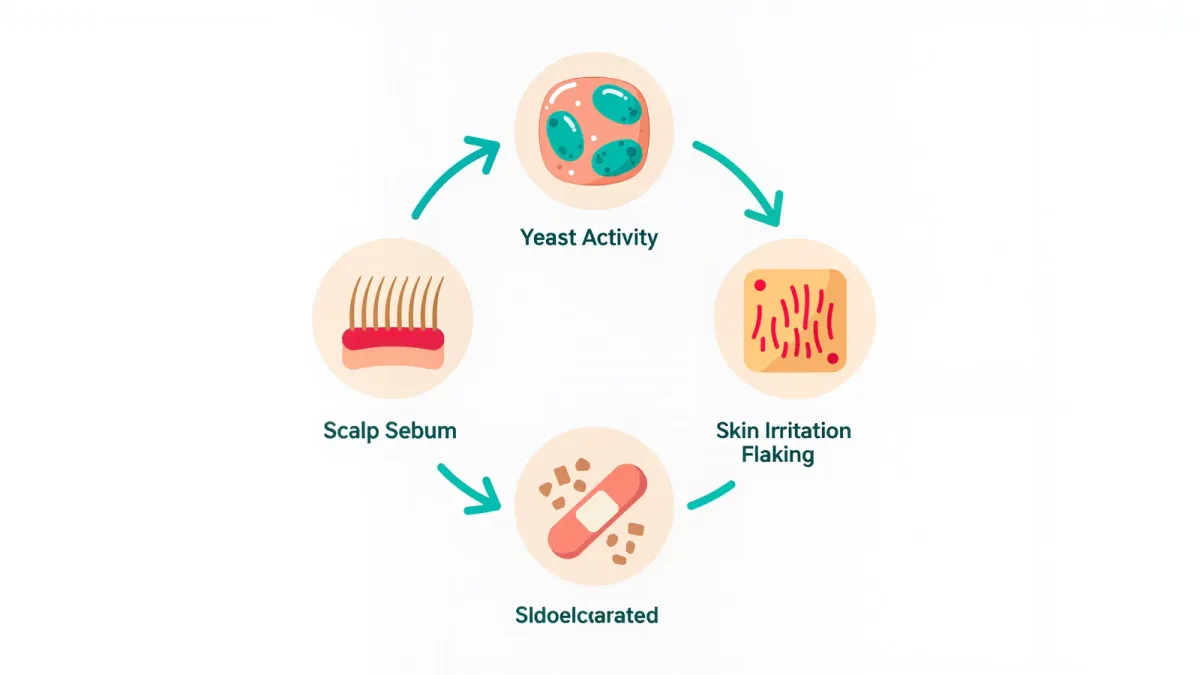
Malassezia globosa feeds on the triglycerides in your scalp's sebum and releases oleic acid as a byproduct. In people who are susceptible, that oleic acid irritates the skin, and the scalp responds by shedding cells at an accelerated rate — research summarized in a 2012 review by Graham Turner and colleagues in the International Journal of Cosmetic Science described dandruff as a state of disorganized, compromised scaling of the scalp's outer layer rather than simple dryness. The visible result is white or yellowish flakes, often with itching, that worsen when sebum runs high.
Is dandruff the same as dry scalp?
No, and the difference decides the treatment. Dry-skin flakes are small, white, and come with tightness — typically triggered by cold air, over-washing, or harsh products, and they improve with moisturizing. Dandruff flakes are larger, often cling to the hair root with a slight yellow tint, and the scalp is oily rather than tight. Treating yeast-driven dandruff with moisturizer alone does nothing for the underlying process, and treating genuinely dry scalp with strong antifungals is unnecessary. Per the Mayo Clinic, seborrheic dermatitis is the more severe relative: redder skin, greasier scales, and sometimes involvement of the eyebrows, nose sides, and ears.
Who gets dandruff?
Risk rises with several factors, per Mayo Clinic guidance and dermatology reviews: age between roughly 10 and 50, when sebum production peaks; being male; oily scalp conditions; a weakened immune system; and neurological conditions including Parkinson's disease, which are associated with more severe seborrheic dermatitis. Dandruff is not caused by poor hygiene, a common and unfair assumption — the yeast colonizes clean scalps as readily as unwashed ones, though infrequent washing lets sebum and flakes accumulate visibly.
Do certain habits make it worse?
- Heavy styling products — buildup mixes with sebum and flakes, making shedding more visible.
- Harsh, infrequently rinsed shampooing — irritation compounds irritation, though the yeast itself is unaffected.
- Stress — dermatologists commonly report seborrheic dermatitis flares during stressful periods, though controlled evidence is limited.
- Cold, dry seasons — flares often worsen in winter, per the Mayo Clinic.
Which treatments actually work?
Over-the-counter medicated shampoos are the first line, and the active ingredient matters more than the brand. Per the Mayo Clinic, the proven options are zinc pyrithione, ketoconazole (1 percent over the counter, 2 percent by prescription), selenium sulfide, salicylic acid, and coal tar. Randomized trials and comparative studies published since the 1990s have found 2 percent ketoconazole shampoo among the most effective for dandruff and seborrheic dermatitis, with zinc pyrithione close behind.
- Pick one active ingredient and use the shampoo two to three times weekly, leaving it on the scalp for five minutes before rinsing — contact time is where most people fail.
- Massage into the scalp, not just the hair; the treatment targets skin.
- Give it a month. If flaking persists, rotate to a different active — resistance and individual response both vary.
- Once controlled, once-weekly use often maintains results, per dermatology guidance.
Coal tar is the odd one out: it slows cell turnover rather than fighting the yeast, can stain light hair, and increases photosensitivity — use sun protection after it.
Does dandruff cause hair loss?
Not directly. Dandruff itself does not kill follicles, but aggressive scratching can damage hair shafts, and severe scalp inflammation is worth treating for its own sake, per the American Academy of Dermatology's guidance on scalp conditions. If you notice shedding alongside flaking, the priority is calming the scalp — and if hair loss continues after the flaking clears, that is a separate question for a dermatologist.
Can diet or home remedies fix it?
The popular remedies — tea tree oil, apple cider vinegar, coconut oil — have thin or conflicting evidence. Tea tree oil shampoo showed some benefit in a small 2002 randomized trial in the Journal of the American Academy of Dermatology, but concentrations and formulations vary widely across products, and undiluted tea tree oil causes contact dermatitis in some people. There is no solid evidence that diet changes dandruff, and vinegar carries its own irritation risk. Medicated shampoos cost about the same and carry much better data.
When to talk to a clinician
See a dermatologist if over-the-counter shampoos fail after a month of correct use, if your scalp is red, swollen, or crusted, if flakes come with patchy hair loss, or if scaling spreads to your face or chest. Severe seborrheic dermatitis and scalp psoriasis look similar to dandruff and need prescription treatment.
The bottom line
Dandruff is mostly your scalp reacting to Malassezia yeast, not dryness or poor hygiene — a 2012 International Journal of Cosmetic Science review framed it as disordered, compromised scaling driven by that interaction. Medicated shampoos with zinc pyrithione or ketoconazole, used two to three times weekly with five minutes of contact time, clear most cases within a month; anything stubborn, painful, or spreading belongs with a dermatologist.