
Most adults need about 25 grams of fiber a day if they are women and about 38 grams if they are men, based on the adequate intake values set by the Institute of Medicine in its 2005 Dietary Reference Intakes. The same panel put the official number at 14 grams for every 1,000 calories you eat, which is where those day-long targets come from. By those benchmarks, most people fall short: per the Dietary Guidelines for Americans 2020–2025, more than 90 percent of women and 97 percent of men in the United States do not meet recommended intakes of dietary fiber.
One thing before the details: this site publishes information, not medical advice. If you have a digestive condition such as irritable bowel syndrome or inflammatory bowel disease, or you take medications that fiber can affect, talk with a clinician or registered dietitian before making big changes to how much fiber you eat.
What does fiber actually do?
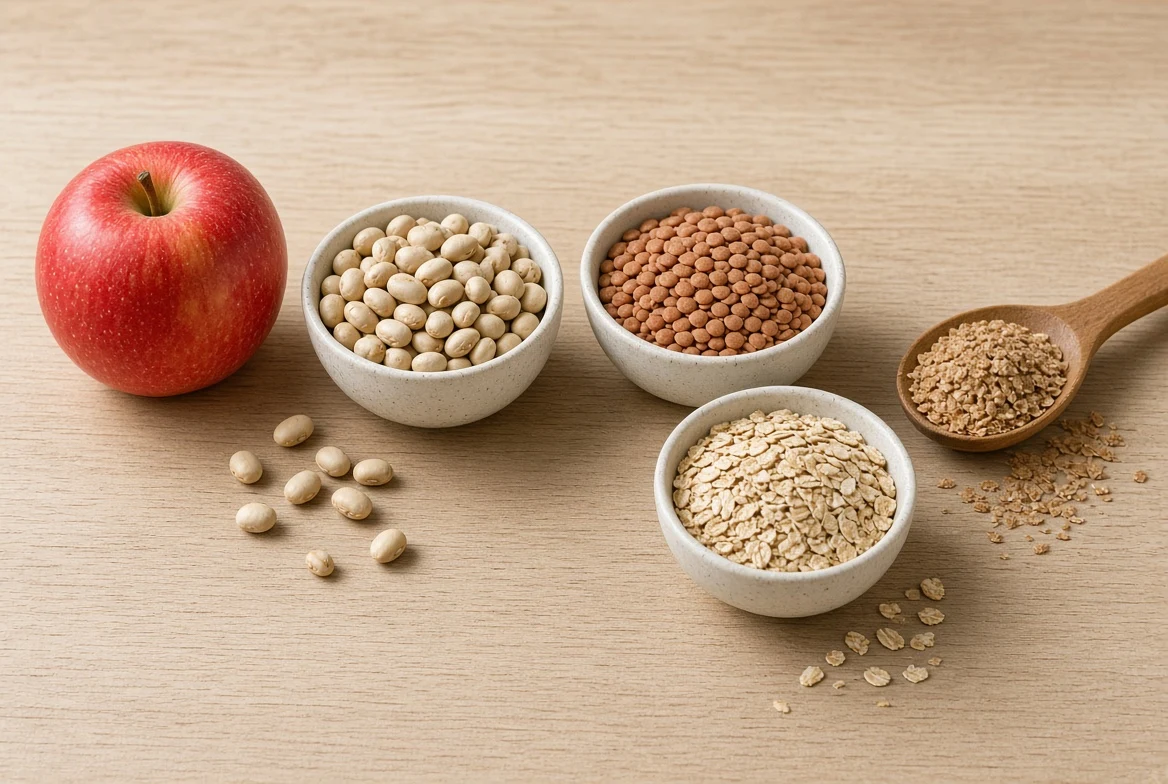
Fiber is the part of plant foods your body does not digest, and per the National Institute of Diabetes and Digestive and Kidney Diseases, it comes in two broad forms. Soluble fiber, found in oats, beans, apples, and citrus, dissolves in water and forms a gel that slows digestion. Insoluble fiber, found in whole wheat, nuts, and many vegetables, adds bulk and helps food move through the gut. Most plant foods contain a mix of both, which is why food sources beat supplements for most people.
The payoff for eating enough of it is well documented. A 2019 series of systematic reviews in The Lancet, pooling data from 185 prospective studies and 58 clinical trials with more than 4,600 total participants across analyses, found that people eating the most dietary fiber had a 15 to 30 percent lower risk of all-cause mortality, cardiovascular disease, stroke, type 2 diabetes, and colon cancer compared with those eating the least. The authors put the sweet spot for protecting against these outcomes at 25 to 29 grams per day, with higher intakes possibly offering more benefit.
How much fiber per day is right for you?
The reference values are the cleanest answer available. Per the Institute of Medicine's 2005 Dietary Reference Intakes, the adequate intake is 25 grams a day for adult women ages 19 to 50 and 38 grams for men the same age. After age 50 the values drop slightly, to 21 grams for women and 30 grams for men, because total calorie needs typically decline. Children and teens have age-specific values that rise as they grow.
Two honest caveats. First, these are adequate intake figures set by a government-appointed scientific panel, not a recommendation from this site, and individual needs vary. Second, the widely cited target of 30 grams a day is a reasonable public health benchmark, not a hard clinical threshold; there is no test that tells you your personal fiber number.
Soluble or insoluble: does the type matter?
For everyday purposes, tracking total grams matters more than splitting hairs between types, and per the NIH Office of Dietary Supplements, fiber from foods comes packaged with vitamins, minerals, and other plant compounds that isolated fibers do not provide. That said, specific fibers have specific documented effects worth knowing about.
- Beta-glucan in oats and barley is the subject of an FDA-authorized health claim first approved in 1997, allowing foods that supply at least 0.75 grams of beta-glucan per serving to state an association with lower blood cholesterol.
- Psyllium, the fiber in many bulk laxatives, has been shown in multiple randomized trials reviewed by the NIH Office of Dietary Supplements to improve constipation symptoms and modestly lower LDL cholesterol.
- Insoluble fibers such as wheat bran primarily speed transit through the digestive tract, per the National Institute of Diabetes and Digestive and Kidney Diseases.
What foods get you there fastest?
Beans are the outlier. Per USDA FoodData Central, a half cup of cooked lentils delivers roughly 8 grams of fiber, and black beans about 7.5 grams, which means one serving covers a quarter to a third of a day's target. For comparison, per the same USDA database, a medium apple with skin has about 4.5 grams, a half cup of cooked oatmeal about 2 grams, and a slice of whole wheat bread around 2 grams. Nuts, popcorn, raspberries, and vegetables such as broccoli and Brussels sprouts round out the practical list.
Since beans and lentils carry the heaviest load, the simplest fix for most people is putting them into meals you already eat: into soups, salads, tacos, and pasta sauces. Oats at breakfast, fruit with the skin on, and a switch from white to whole grain bread close most of the remaining gap.
Can you eat too much fiber?
Going from very little fiber to a lot in one step usually backfires with gas, bloating, and cramping, per the National Institute of Diabetes and Digestive and Kidney Diseases, which advises increasing intake gradually. A practical pace is one change per week, such as swapping white rice for brown one week, then adding beans the next. Drinking enough water alongside the extra fiber matters too, because soluble fiber needs fluid to do its gelling work.
Very high fiber intakes, especially from supplements, can interfere with the absorption of some medications, including certain drugs for thyroid conditions and diabetes, per the NIH Office of Dietary Supplements. Spacing medications and large fiber doses a few hours apart is the standard precaution it describes.
Do fiber supplements count?
They can, but per the NIH Office of Dietary Supplements, whole foods remain the better first choice because they bring the full package of nutrients, and most supplements deliver a single fiber type. If you use a supplement, it is worth knowing what you are buying: psyllium, methylcellulose, and wheat dextrin behave differently in the gut. Someone with a narrow, self-limited goal, such as occasional constipation, may get what they need from a supplement, but nobody should treat it as a substitute for beans, oats, fruit, and vegetables.
The bottom line
The official reference values are 25 grams of fiber a day for most adult women and 38 grams for men, set by the Institute of Medicine in 2005, and a 2019 Lancet analysis tied intakes of 25 to 29 grams to meaningfully lower risks of heart disease, stroke, type 2 diabetes, and colon cancer. Since the Dietary Guidelines report that over 90 percent of women and 97 percent of men miss the target, the sensible next step is small and specific: add a half cup of beans or lentils to one meal a day, raise your intake gradually over a few weeks, and check with a clinician first if you have a digestive condition or take regular medications.