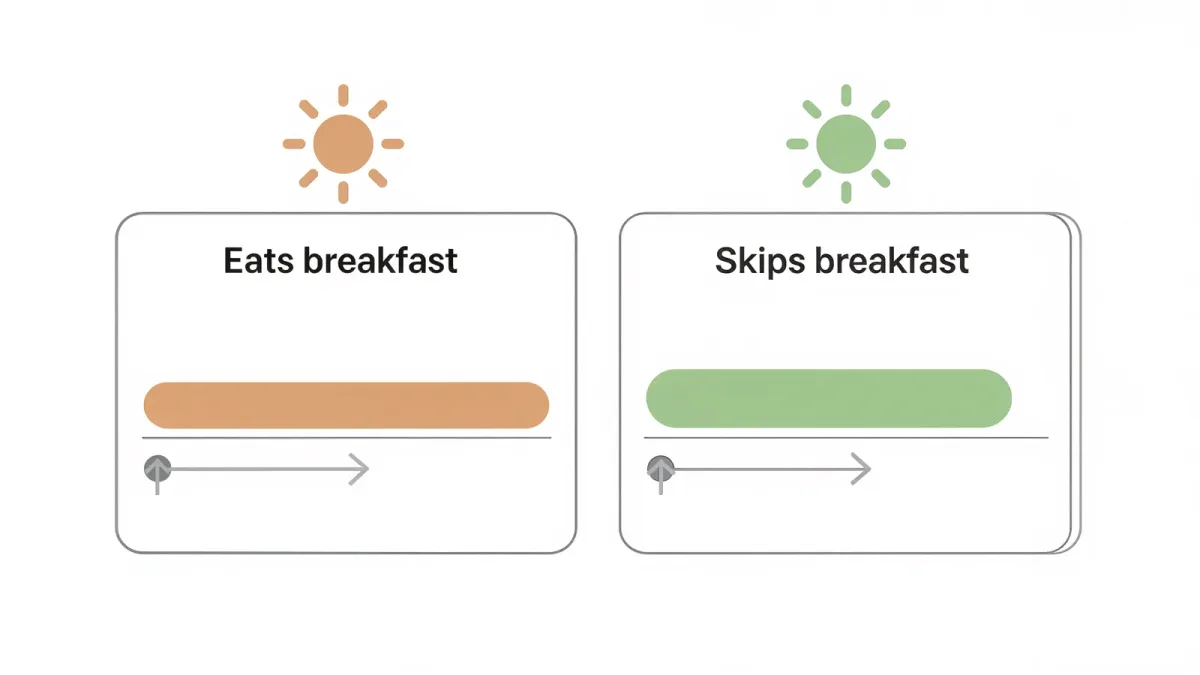
No trial has shown breakfast to be the most important meal of the day, and the weight-control version of the claim does not hold up in randomized research: a 2019 systematic review and meta-analysis of 13 randomized controlled trials published in The BMJ found that people assigned to eat breakfast did not lose more weight than those assigned to skip it, and actually consumed about 260 more total calories per day. Breakfast matters when it matters for you, for appetite, medication timing, or how you concentrate in the morning, but the universal crown on the meal is a belief, not a finding.
If you take diabetes or thyroid medication that interacts with food timing, your eating schedule is a clinical question, not a lifestyle preference.
Where did the breakfast claim come from?
Two places, and knowing them changes how you read diet headlines. The first is observational research: large studies repeatedly found that people who eat breakfast tend to be thinner and healthier than people who skip it. The second is food marketing; the 2013 analysis by Andrew Brown and colleagues in The American Journal of Clinical Nutrition traced how scientific language about breakfast's proposed effects hardened into dogma, and found that authors were far more likely to describe the claim as proven when writing funded by cereal companies.
The observational findings have a well-known alternative explanation, reverse causality: people who are overweight, dieting, or rushing out the door skip breakfast because of their circumstances, not the other way around. That is exactly why randomized trials were needed.
What did the randomized trials find?
The 2019 BMJ meta-analysis by Kimberley Skidmore and colleagues pulled together 13 randomized controlled trials, mostly from the United States and United Kingdom, and reached three conclusions:
- No weight benefit. People assigned to eat breakfast did not lose more weight than those assigned to skip it; small differences slightly favored the skippers, by about 0.4 kilograms.
- More calories, not fewer. Breakfast eaters consumed roughly 260 more calories over the day. Breakfast was an addition to daily intake, not a curb on it.
- The risk of bias was high. The authors flagged that most trials were small, short, and unevenly blinded, and called the widely quoted claim that skipping breakfast causes obesity unsupported by randomized evidence.
A related trial by the Bath group in the same year, the Bath Breakfast Project reported in The American Journal of Clinical Nutrition in 2014, found that lean adults assigned to eat breakfast did not gain less weight over six weeks than those fasting until noon; both groups ended at similar weights, with the breakfast group more physically active in the mornings. The pattern across trials is consistent: the meal itself does not decide body weight, total intake over the day does.
Does breakfast help you think and work better?
For children and in specific situations, there is real signal. Observational studies link eating breakfast with better school attention and performance, and a trial-level summary in children found small benefits on attention and memory on the morning after eating, though the 2019 BMJ authors note the child evidence is weaker and confounded like the adult evidence. For adults, the clearest finding in the 2014 Bath Breakfast Project was behavioral: breakfast eaters moved more during the morning and used more energy that way. The honest reading is that breakfast is a performance variable you can test on yourself, not a settled requirement.
Is skipping breakfast bad for your heart?
Observational data raise a flag worth knowing without overstating: an analysis of more than 26,000 men in the Health Professionals Follow-up Study, published in Circulation in 2013, found that men who reported skipping breakfast had a 27 percent higher risk of coronary heart disease over 16 years of follow-up. That is association, not causation; skippers differed in other ways, including smoking, physical activity, and late-night eating, and randomized trials like the 2019 BMJ analysis do not show skipping itself causing harm. Treat it as one more reason the answer depends on the whole day, not one meal.
Who genuinely benefits from eating breakfast?
Skipping is not for everyone, and some groups have practical reasons a morning meal earns its place:
- Children and teenagers on school mornings, where the attention evidence, imperfect as it is, points toward eating something.
- People taking medications that require food, such as some diabetes drugs, where a missed meal is a safety issue, per medication guidance from the NIH's MedlinePlus.
- Anyone whose mornings fall apart without it. If skipping turns into uncontrolled hunger and grazing by 11 a.m., the 260-calorie finding from the BMJ analysis cuts in your favor when you eat deliberately rather than reactively.
Conversely, if you are not hungry until late morning and your total intake stays reasonable, nothing in the randomized evidence says you must force breakfast.
So what should a good breakfast be?
Given that eating breakfast is optional but not useless, the content is the part worth engineering. Per the Dietary Guidelines for Americans 2020-2025, most Americans over-consume added sugars, sodium, and refined grains and under-consume fiber, and the typical sweetened-cereal-and-juice breakfast leans the wrong way on all three. Protein and fiber together, eggs with vegetables, plain yogurt with berries and nuts, oats, carry satiety further into the day than a pastry or a smoothie built from juice.
The bottom line
The phrase most important meal of the day is marketing and observational inference, not trial evidence: a 2019 meta-analysis of 13 randomized trials in The BMJ found breakfast added about 260 daily calories and produced no weight benefit, and an observational 2013 Circulation analysis keeps skipping-breakfast heart risk on the radar without proving causation. The practical answer is personal: eat a protein-and-fiber breakfast if it steadies your morning, take your medication timing into account, and do not force the meal if your total day works without it. If you are unsure where to start, track your full-day intake for a week, with and without breakfast, and judge by the whole day.