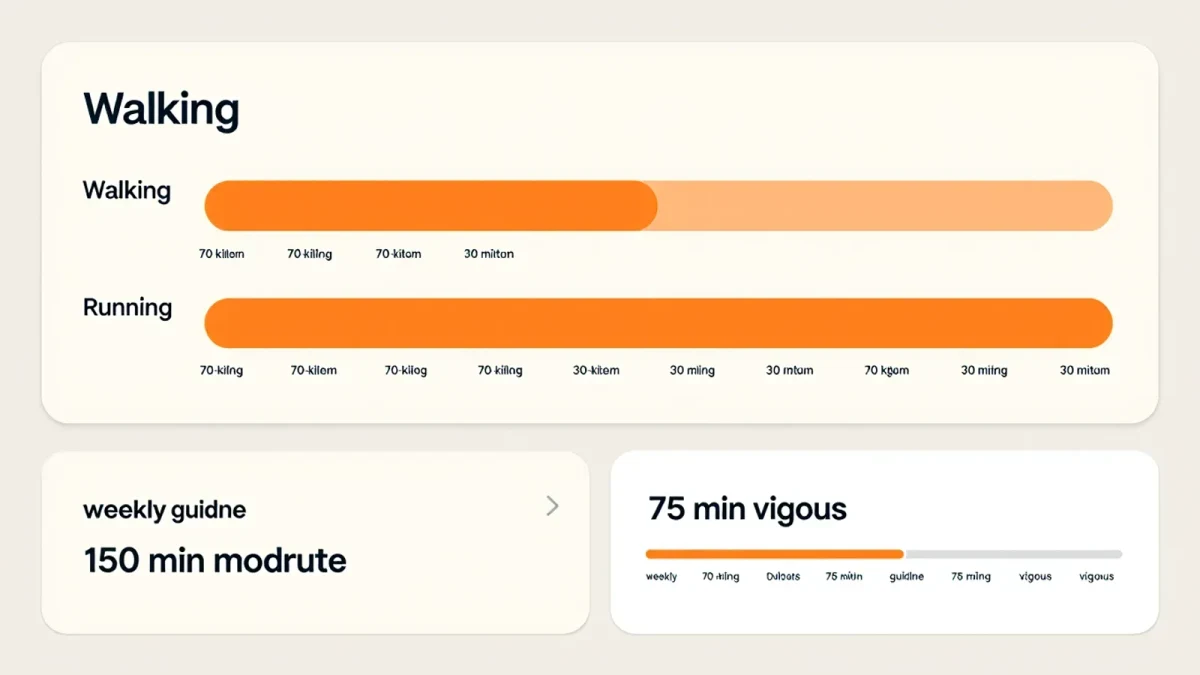

For heart health, walking and running deliver broadly similar benefits when the total energy burned is the same — a 2015 systematic review of 33 studies in Sports Medicine (Murtagh and colleagues) found no clear difference in cardiovascular risk reduction between walkers and runners matched for energy expenditure. Running simply buys those benefits in less time, while walking buys them with far less impact on joints and a much lower injury rate. Which one is "better" for you is mostly a question of your joints, your schedule, and how much time you can give.
If you have heart disease, joint problems, or symptoms during activity, talk with a clinician about what level and type of exercise is safe.
Is walking really as healthy as running?
Per minute of time, no; per unit of energy, largely yes. The 2015 Sports Medicine review (Murtagh and colleagues) pooled observational studies and found that when walkers and runners burned comparable amounts of energy, both showed lower risks of high blood pressure, high cholesterol, diabetes, and possibly coronary heart disease, with results more consistent for hypertension than for other outcomes. A separate large cohort analysis in Arteriosclerosis, Thrombosis, and Vascular Biology (Williams and Thompson, 2013) reached a slightly different conclusion: for the same energy expenditure, running was associated with greater risk reductions for some conditions, including diabetes and hypertension, than walking. The honest reading of the two together: walking captures most — not all — of running's cardiometabolic benefit, and needs roughly double the time to burn the same energy.
How many calories does each burn?
Running burns roughly twice the energy per minute of brisk walking. Estimates from the federal guidelines' calorie appendix (Physical Activity Guidelines for Americans, 2nd edition, HHS, 2018), for a person of about 154 pounds: a brisk 3.5 mph walk uses roughly 280 calories in an hour, while running at 5 mph uses roughly 590. Running also reaches the moderate-to-vigorous zone almost automatically, whereas brisk walking sits at the moderate threshold — so walkers need to keep the pace honest to make sessions count toward the recommended 150 weekly minutes of moderate activity.
Which is easier on your knees and joints?
Walking, clearly — and the running story is more nuanced than the locker-room myth. Each running stride loads the knee with force several times body weight, while walking keeps ground reaction forces near one to 1.5 times body weight. Yet running is not established as a cause of knee osteoarthritis: a 2017 systematic review and meta-analysis in the Journal of Orthopaedic & Sports Physical Therapy (Alentorn-Geli and colleagues) found recreational runners had a lower prevalence of hip and knee osteoarthritis than sedentary non-runners (3.5 percent versus about 10 percent), with only competitive elite-level runners showing elevated rates. The realistic joint risk with running is injury from training load, not arthritis.
Which causes more injuries?
Running, by a wide margin. A frequently cited review in the British Journal of Sports Medicine (van Gent and colleagues, 2007) reported annual injury rates in runners ranging from roughly 20 to 79 percent, with the knee the most common site — numbers recreational walkers never approach. Most running injuries are overuse problems tied to abrupt increases in training volume, so gradual progression matters more than footwear brand, and walkers starting a running program should alternate running and walking intervals for the first weeks.
How do you choose between them?
Match the activity to your body and constraints:
| Factor | Walking | Running |
|---|---|---|
| Heart/metabolic benefit | Similar at equal energy (Sports Medicine, 2015) | Same benefits, less time |
| Time cost | ~2x longer for same calories | High energy burn per minute |
| Injury risk | Low | Up to ~79% annually (BJSM, 2007) |
| Joint impact | Low forces | High forces, but recreational running not linked to higher OA |
| Best fit | Beginners, joint pain, long consistency streaks | Time-crunched, existing base, goals of pace or racing |
A hybrid is not a compromise — it is the standard recommendation: walk on most days, run once or twice a week if you enjoy it, and let the federal benchmark of 150 moderate minutes be the scoreboard that both sports feed.
How do you start if you currently do neither?
Start with walking, because the adherence research favors the easier entry point: habit studies tracking new exercise behaviors found low-intensity starts are the ones people keep. A practical on-ramp: walk briskly for 20-30 minutes on five days of the week for your first two weeks — brisk means you can talk in sentences but not sing, the moderate-intensity test the 2018 federal guidelines use. From week three, if your knees and schedule allow, add two sessions of alternating one minute of easy jogging with four minutes of walking, repeated four to six times. Expand the jogging intervals gradually over the following month. Both activities count fully toward the recommended 150 weekly minutes of moderate activity, so there is no wrong door — only the one you will actually walk through.
When should you talk to a clinician?
See a clinician before running if you have chest symptoms with exertion, unexplained dizziness, a history of stress fractures, significant hip or knee pain, or you are returning from injury. During either activity, stop and get advice about pain that worsens mid-stride, joint swelling that persists overnight, or pain that changes the way you walk.
The bottom line
At equal energy burned, walking and running show similar cardiovascular benefit (Sports Medicine, 2015); running gets you there faster, walking gets you there with a fraction of the injury risk (BJSM, 2007). Choose the one you will still be doing in six months — consistency, not modality, is the variable the research keeps rewarding. Start with 20-30 brisk minutes and add time before you add speed.