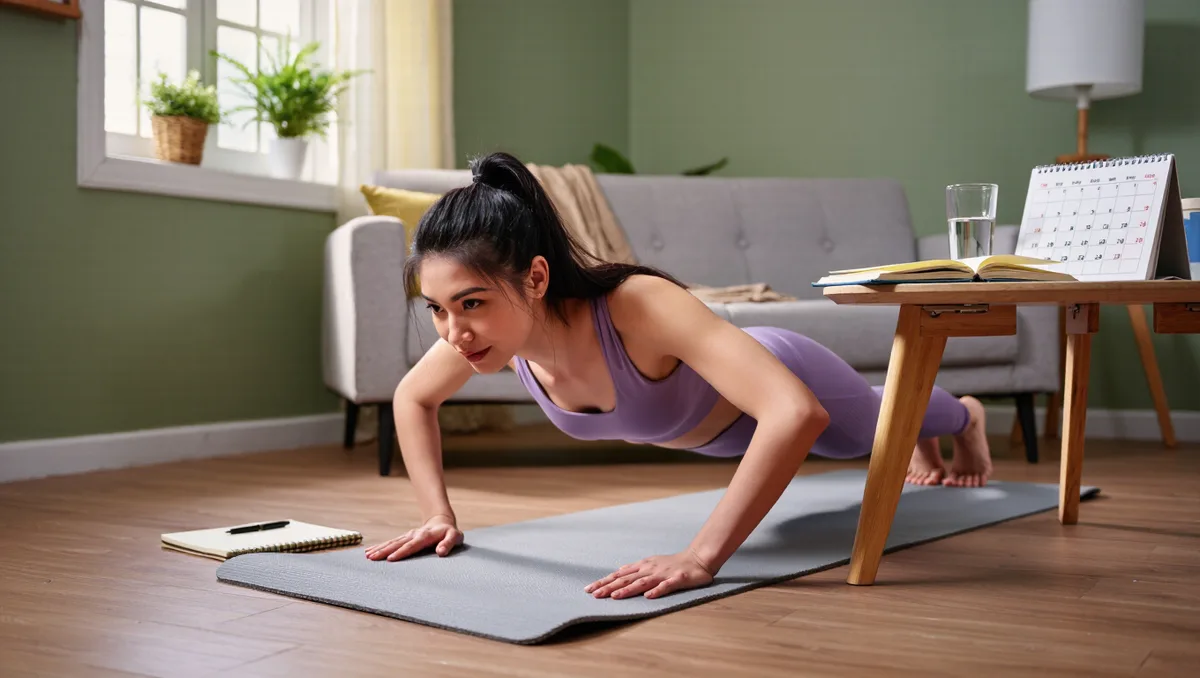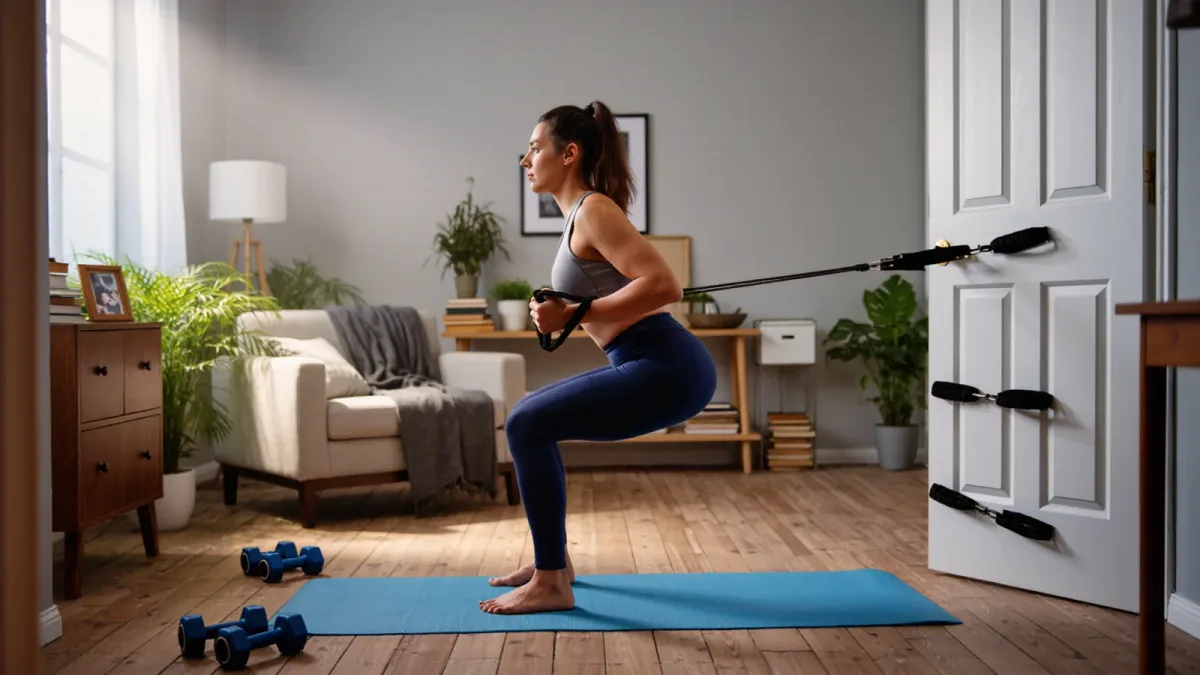
A no-equipment home workout works: a 20-minute circuit of five bodyweight movements — squats, push-ups, hinges, rows, and planks — done three times a week satisfies the federal muscle-strengthening benchmark (Physical Activity Guidelines for Americans, 2nd edition, HHS, 2018), and research shows bodyweight training can match equipment training. The clearest evidence comes from a 2015 study in the Journal of Strength and Conditioning Research (Calatayud and colleagues), which found that a push-up loaded with a resistance band produced muscle activation in the chest and arms comparable to the bench press at comparable intensity. Your living room is a legitimate gym; the plan below is how to use it.
If you have a heart condition, uncontrolled blood pressure, joint problems, or you are new to exercise after a long sedentary period, get a clinician's input on safe intensity first.
Can you really build strength without weights?
Yes — the stimulus that builds muscle is tension and progressive effort, and bodyweight movements supply both when they are made hard enough. The 2015 Calatayud study is the headline, and the broader literature agrees: ACSM includes bodyweight training among recognized strength-training modalities, and its guidance describes one to three sets of 8-12 repetitions to near-fatigue as an effective dose regardless of the resistance source. The catch is progression: a standard push-up stops being hard for most people within weeks, so a home program lives or dies on finding harder versions. Elevate your feet for push-ups, slow the lowering phase to three seconds, move from assisted to full to single-leg squats — each step restores the challenge that drives adaptation.
What are the five movements that cover everything?
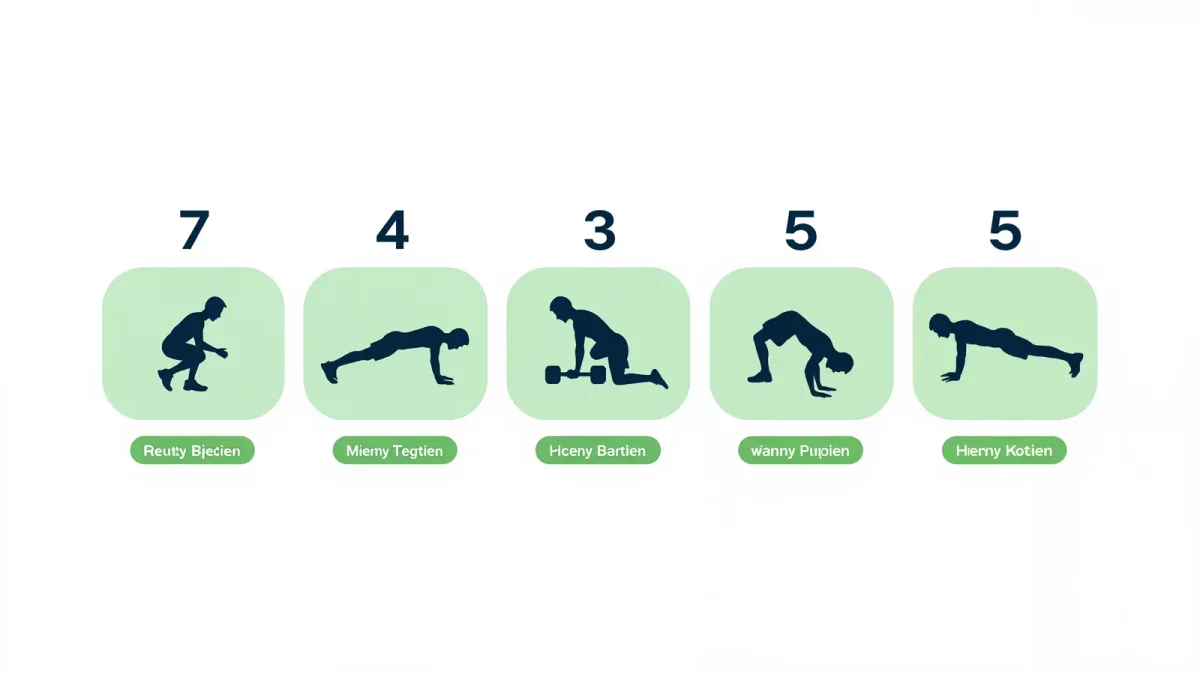
A complete bodyweight program needs a push, a pull, a squat, a hinge, and a core brace — the same patterns any gym program is built on:
- Squat: bodyweight squat, or sit-to-stand from a sturdy chair to make it easier; progress to split squats.
- Push: wall or knee push-ups to start, full push-ups, then feet-elevated push-ups.
- Pull: the hardest pattern without equipment — use a sturdy table for inverted rows (lie beneath, pull your chest to the edge), a doorframe row with a towel, or towel rows around any fixed anchor.
- Hinge: good mornings and single-leg deadlift reaches — hips back, flat back, hamstrings loading.
- Core brace: plank or dead bug, 20-40 seconds per set.
Run them as a circuit: one set of each in order, resting 30-60 seconds between movements, and repeat the circuit two to three times. Stop each set one or two repetitions before form breaks — near-effort, not collapse. Beginners can start with a single circuit and add one each week; the whole session fits in twenty minutes at that pace.
What does a full week look like at home?
| Day | Session |
|---|---|
| Monday | 20-minute strength circuit (above) |
| Tuesday | 25-30 minutes brisk walk, bike, or stair climbing |
| Wednesday | Rest or gentle stretching |
| Thursday | 20-minute strength circuit |
| Friday | 25-30 minutes moderate cardio |
| Saturday | Optional third circuit or long walk |
| Sunday | Rest |
That structure meets both federal benchmarks — 150 weekly minutes of moderate aerobic activity plus two or more strength days (HHS, 2018) — with no equipment and no commute.
How do you keep progressing without adding weight?
Manipulate the four progression levers ACSM's guidance identifies for resistance exercise, adapted to bodyweight:
- Harder variations — elevate push-up feet, move toward single-leg squats, slow the tempo to three seconds down.
- More repetitions or sets — add reps until you reach the top of the 8-15 range, then add a set or a harder version.
- Shorter rests — cutting rest from 60 to 30 seconds raises the demand of the same circuit.
- Full range and control — deep, unhurried repetitions stress muscle more than fast partial ones.
When a movement stops feeling like effort in the 8-15 repetition window, it has stopped being strength training — upgrade the version rather than piling on reps.
What are the most common home-workout mistakes?
Three account for most stalled or painful home programs. First, skipping the pull pattern, which leaves shoulders pulled forward by all the pushing — anchor a towel somewhere and row weekly. Second, rushing repetitions: controlled tempo is both safer and more productive, and ACSM material emphasizes controlled movement for safety and effect. Third, ignoring pain signals — joint pain that sharpens mid-repetition or lingers the next day is a variation problem, solved by easier versions rather than endurance. A mirror or a phone camera propped to record form catches most technique faults a gym trainer would flag — a two-minute check worth doing monthly.
When should you talk to a clinician?
Get medical input before starting if you have chest symptoms with exertion, uncontrolled blood pressure, a history of joint or back injuries, or you are returning to exercise after surgery or a long layoff. During training, stop and seek advice about sharp joint pain, dizziness, chest discomfort, or pain that persists more than a few days after a session.
The bottom line
Bodyweight training is evidence-backed strength training: comparable muscle activation to equipment work at matched effort (Journal of Strength and Conditioning Research, 2015), and a 20-minute five-movement circuit three times a week meets the federal strength benchmark (HHS, 2018). Learn the five patterns, progress the versions when reps get easy, do not skip the pull, and schedule it — the equipment you were missing was never the limiting factor.