
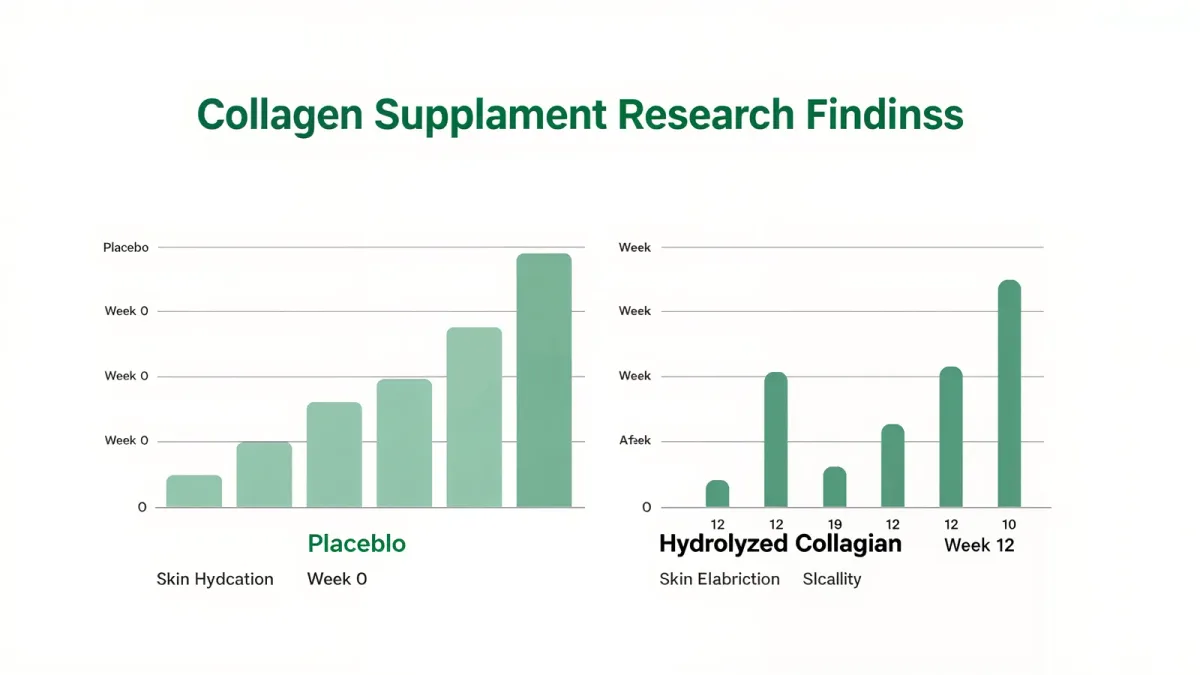
Probably a little — with caveats worth knowing before you buy. A 2021 meta-analysis in the International Journal of Dermatology pooled 19 randomized trials and found that hydrolyzed collagen supplements improved skin hydration and elasticity compared with placebo, with effects typically appearing after about 8 to 12 weeks of daily use. The gains were modest, not dramatic, and most of the trials were small and industry-funded.
If you have a medical condition, take prescription medication, or notice new skin changes, talk with a clinician rather than self-treating with supplements.
What is collagen, and why do supplements exist?
Collagen is the most abundant protein in your body and the main structural protein of skin — it forms the scaffold that keeps skin firm. From your twenties onward, collagen production gradually declines, which is why skin thins and wrinkles with age. Supplement makers sell hydrolyzed collagen, also called collagen peptides: collagen broken into smaller fragments that are easier to absorb. The idea is that these fragments or their breakdown products reach the skin and either supply building blocks or signal skin cells to step up their own collagen production.
What does the research actually show?
The 2021 meta-analysis in the International Journal of Dermatology, led by Davidson de Miranda and colleagues, reviewed 19 studies with more than 1,100 participants and concluded that hydrolyzed collagen supplementation improved skin elasticity and hydration. A 2019 randomized trial by Lisa Bolke and colleagues in the journal Nutrients found that 2.5 grams of specific collagen peptides daily for 8 weeks improved skin elasticity, with effects still detectable four weeks after participants stopped.
That is the positive case. Now the honest part: trial durations are short, typically 8 to 12 weeks, so there is no good evidence about years-long use. Sample sizes are small — often a few dozen to a few hundred people per arm. And per the 2021 meta-analysis itself, most included trials were funded or supplied by supplement manufacturers, which is a known source of bias in nutrition research. Independent replication has been thinner.
How does a supplement reach your skin?
Digestion breaks collagen peptides down further, but research summarized in the 2021 meta-analysis suggests some fragments survive, enter the bloodstream, and accumulate in skin, where they may stimulate fibroblasts — the cells that build collagen — rather than simply being pasted into wrinkles. That mechanism is plausible and partly supported by skin-biopsy data in trials; it is not the same as proven, visible wrinkle reversal.
What about collagen creams?
Topical collagen is a different story. Collagen molecules are far too large to pass through the skin barrier, so collagen creams can moisturize but cannot rebuild the dermal scaffold. The evidence discussed above is about oral supplements, and the 2021 meta-analysis does not extend to face creams. Products marketed as 'topical collagen therapy' are promising something the science does not support.
Is collagen safe?
Trials have generally reported few side effects at doses around 2.5 to 10 grams daily, and the US Food and Drug Administration regulates supplements as food, not drugs — meaning products reach shelves without pre-market efficacy testing. Per NIH consumer guidance on supplements, quality and purity vary between brands, and collagen powders are not risk-free for people with fish, egg, or shellfish allergies, since many products derive from those sources.
Do you need it, or is food enough?
There is no recommended dietary allowance for collagen — your body makes it from amino acids found in ordinary protein foods: meat, fish, eggs, dairy, beans. Vitamin C is required for collagen synthesis, which is why a diet adequate in vitamin C matters more than any powder. Per the NIH Office of Dietary Supplements, adults need 75 to 90 milligrams of vitamin C daily, an amount easily met with citrus, peppers, and broccoli. A supplement is an option, not a requirement, for people already eating enough protein.
What the evidence does not tell you
Most trials enrolled middle-aged adults with visible skin aging; results in younger users are unstudied. No trial has shown collagen supplements reduce deep wrinkles, lift sagging, or outperform simply eating adequate protein. Effects on nails and hair are even less studied than skin. And nobody has shown that adding collagen to coffee or a smoothie works differently from taking it in water.
How do you pick a product if you decide to try one?
Because the FDA does not verify supplement contents before sale, third-party certification matters more than marketing. Look for products certified by USP, NSF International, or Informed Choice, which test that the bottle contains what the label claims. Check the peptide dose against what trials used — 2.5 grams is the low end of the studied range — and note whether the manufacturer funded the study it cites, a common pattern in this category per the 2021 meta-analysis. Flavor and format are preference; evidence is not.
When to talk to a clinician
Sudden skin changes, rashes, or unusual bruising deserve medical attention regardless of your supplement routine.
The bottom line
Collagen supplements are not snake oil and not a miracle: a 2021 meta-analysis of 19 trials in the International Journal of Dermatology found modest improvements in skin hydration and elasticity after 8 to 12 weeks, mostly in small, manufacturer-funded studies. If you choose to try one, pick a third-party-tested product, give it 12 weeks, and hold expectations at 'subtle.' Adequate protein and vitamin C remain the free, proven foundation.