
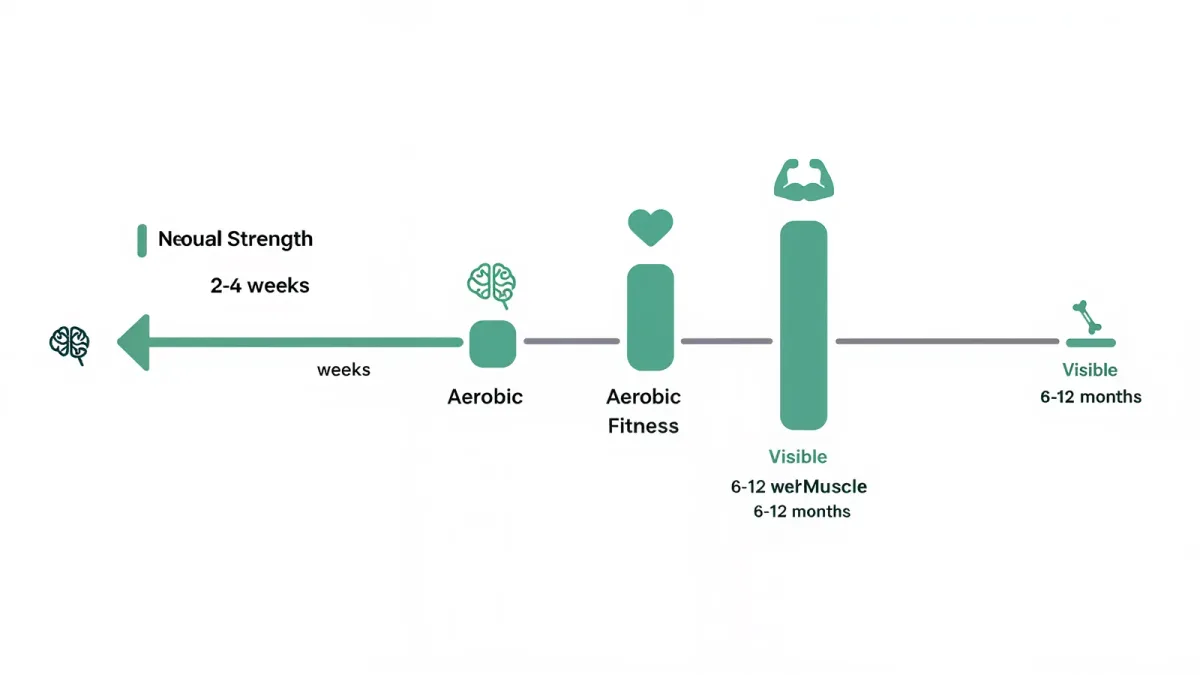
Expect the first real results in two to four weeks — better mood, easier breathing, and strength that climbs quickly — while visible muscle changes generally take 6-12 weeks of consistent training, and bone-density changes take months, per ACSM's resistance-training progression models and the underlying literature. The order is fixed because the adaptations run in sequence: your nervous system learns first, your fitness follows, your muscles grow after that, and your skeleton changes last. Knowing the timeline is the difference between quitting in week three and recognizing week three for what it is — the scheduled first installment.
If you are starting exercise with a chronic condition, get a clinician's input on safe intensity first.
What changes in the first two to four weeks?
Strength and mood move first, and neither is yet about bigger muscles. Research on early strength gains shows the first weeks are dominated by neural adaptations — better coordination, more efficient muscle recruitment — rather than muscle growth (Gabriel, Kamen, and Frost, review in Sports Medicine, 2006). This is why total beginners often add weight to the bar every session for the first few weeks. Cardiovascular fitness also responds early: measurable improvements in VO2 max typically appear within two to four weeks of regular aerobic training in previously sedentary adults, per studies of aerobic adaptation reviewed in ACSM materials. Mood shifts fastest of all — a Cochrane review of exercise for depression (Cooney and colleagues, 2013) found exercise had a moderate beneficial effect compared with no treatment, and the short-term mood lift after individual sessions is one of the most consistently replicated findings in exercise psychology.
When do visible changes appear?
For most people, noticeable muscle shape and firmness take about 6-12 weeks of consistent training. ACSM's review of resistance-training progression models (American College of Sports Medicine position stand, 2009) notes that measurable muscle hypertrophy generally requires at least eight weeks of progressive training, with the fastest visual changes in people who begin untrained. Body composition follows the same clock: the 2012 review by Westcott (Journal of Strength and Conditioning Research) found adults gained about 1.4 kg of lean mass and lost about 1.8 kg of fat across the first ten weeks of regular strength training — real change, though mirror-visible change usually lags the measurements by a few more weeks. One caveat the evidence does not support: expecting specific body-part transformation or fast dramatic change. Timelines in the research describe averages under consistent conditions, not guarantees.
How long for endurance, flexibility, and bone?
Different systems run on different clocks:
| Adaptation | Typical first measurable change | Evidence anchor |
|---|---|---|
| Strength (neural) | 2-4 weeks | Sports Medicine review, 2006 |
| Aerobic fitness (VO2 max) | 2-4 weeks | ACSM aerobic adaptation literature |
| Muscle size / visible change | 6-12 weeks | ACSM position stand, 2009 |
| Flexibility | 3-8 weeks of regular stretching | ACSM flexibility guidance |
| Bone density | 6-12 months | LIFTMOR trial measured at 12 months (Watson et al., 2018) |
Bone is the slowest because bone remodeling cycles take months — the 2018 LIFTMOR trial of heavy resistance training in postmenopausal women measured meaningful bone mineral density improvements at twelve months, not twelve weeks.
Why do results stall after the first few months?
Because adaptation is steepest from zero. The fastest gains of your training life come in the first three to six months; after that, the same stimulus produces smaller returns, and progress depends on progressive overload — adding weight, reps, or difficulty over time. ACSM's progression models describe increasing training load as fitness improves as the principle driving continued adaptation. Two honest notes from the research: missing a few days costs little, since habit research from University College London (Lally and colleagues, 2010) found single missed days did not derail habit formation; but repeated interruptions do slow progress, because detraining begins eroding fitness within two to four weeks of complete rest (Sports Medicine review, Mujika and Padilla, 2000).
How do you measure progress when the mirror is slow?
Track inputs and performance, which move earlier than appearance — a training log turns invisible week-to-week change into a visible line on a page:
- Performance: weight lifted, reps completed, walking or running pace at the same effort, stairs without heavy breathing.
- Function: how your joints feel after activity, sleep quality, energy in the afternoon.
- Numbers: resting heart rate trends downward with aerobic training in many people — worth noting monthly, not daily.
Photograph and measure on a monthly cadence, not weekly; the noise of day-to-day fluctuation is larger than the signal at that timescale.
When should you talk to a clinician?
Seek advice if you train consistently for twelve weeks with no change in strength or endurance at all — thyroid issues, medication effects, and sleep disorders are among the reasons progress can be blunted, and they deserve evaluation rather than more training volume.
The bottom line
Workout results arrive on a documented schedule: neural strength and fitness in 2-4 weeks, measurable muscle and visible change in 6-12 weeks, bone benefits over six months or more (Sports Medicine, 2006; ACSM, 2009; Journal of Bone and Mineral Research, 2018). Judge yourself on a monthly scorecard of performance, not a weekly one of the mirror — and treat week three, when most people quit, as exactly when the compounding starts.