
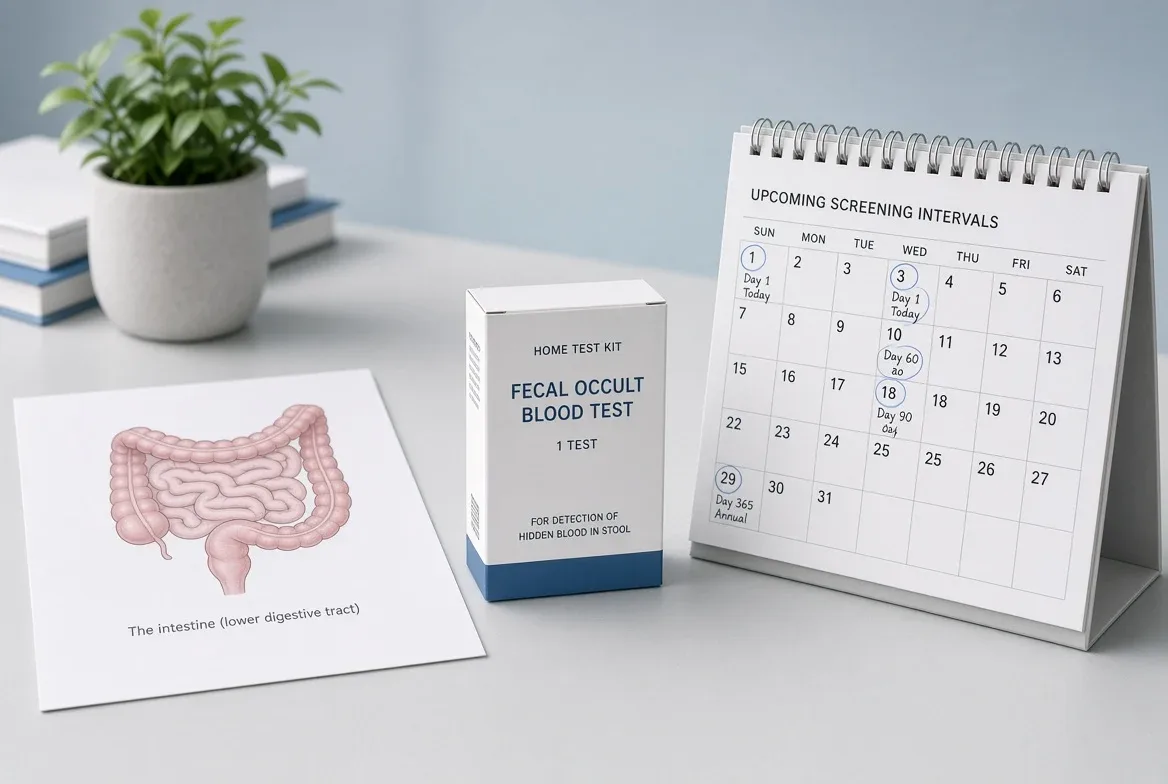
Colorectal cancer screening for adults at average risk should begin at age 45 and continue through 75, using one of several tests approved for that purpose, according to the U.S. Preventive Services Task Force's 2021 recommendation and the Centers for Disease Control and Prevention. The options range from an annual take-home stool test to a colonoscopy every 10 years, and the right choice depends on personal risk, tolerance for preparation, and how a person weighs frequency against invasiveness.
Colorectal cancer is cancer that begins in the colon or rectum, usually starting as a polyp, a small growth on the inner lining of the large intestine that can turn cancerous over years if left in place. Screening exists because most colorectal cancers develop slowly from these polyps, which gives tests time to catch either the polyp itself or an early-stage cancer before symptoms appear. The Task Force gave screening for adults ages 50 to 75 its highest rating, an A grade, and gave screening for adults 45 to 49 a B grade, meaning there is moderate-to-high certainty the benefit is substantial. For adults 76 to 85, the recommendation is a C grade: screening may still help, but the decision should be individualized based on health status, prior screening history, and personal preference, per the USPSTF.
Why does screening start at 45 instead of 50?
The Task Force lowered its recommended starting age from 50 to 45 in 2021 after reviewing evidence that colorectal cancer rates in adults under 50 had been rising, a trend regulators wanted screening guidance to reflect. The American Cancer Society, in a 2026 update to its own screening guideline published in CA: A Cancer Journal for Clinicians, kept 45 as the recommended starting age for average-risk adults and continued to recommend screening through 75 for those with a life expectancy of more than 10 years, while advising against starting new screening after 85. The shift reflects population-level surveillance rather than a new understanding of individual risk factors, and it applies to people considered average risk, not those with a personal or family history that would call for earlier or more frequent testing.
People with inflammatory bowel disease, a personal or family history of colorectal cancer or precancerous polyps, or a hereditary condition such as Lynch syndrome or familial adenomatous polyposis are considered higher risk and generally need to start screening earlier and be screened more often, according to the CDC. Anyone in one of those categories should discuss a personalized schedule with a clinician rather than following the average-risk timeline described here.
What are the different screening test options?
Guidelines from the USPSTF and CDC describe two broad categories of tests: stool-based tests done at home and structural exams done in a clinical setting. Each has a different interval, and choosing one over another is a legitimate personal decision, not a matter of one test being uniformly superior.
| Test | Type | Recommended interval |
|---|---|---|
| Colonoscopy | Structural exam | Every 10 years |
| Fecal immunochemical test (FIT) or high-sensitivity guaiac fecal occult blood test | Stool-based | Every year |
| Multi-target stool DNA test (marketed as Cologuard) | Stool-based | Every 1 to 3 years |
| CT colonography | Structural exam | Every 5 years |
| Flexible sigmoidoscopy | Structural exam | Every 5 years, or every 10 years combined with annual FIT |
The American Cancer Society's 2026 update added two newer options to its guideline: a multi-target stool RNA test, which analyzes stool for RNA markers alongside hemoglobin and is recommended on a three-year interval, and a blood-based test that detects tumor DNA circulating in the bloodstream. The society's update frames the blood test as an option for people who decline the preferred stool-based or structural tests, not as a first-choice substitute for them, according to the guideline's authors. A colonoscopy remains the only test in this group that is both a screening tool and, when a polyp is found, a treatment: the clinician can remove the polyp during the same procedure. Any positive result from a stool-based or blood-based test needs to be followed up with a diagnostic colonoscopy, per CDC guidance, since those tests flag a possible problem rather than confirm one.
What does the evidence say about how well screening works?
The rationale for screening rests on the idea that removing precancerous polyps prevents cancer from developing, and that catching cancer at an early stage sharply improves survival. The American Cancer Society's 2026 guideline update cites five-year survival above 90 percent when colorectal cancer is caught early, a figure the society attributes to the value of catching disease before it spreads beyond the colon or rectum. The Task Force's own recommendation statement is built on a review of the trial and cohort evidence for each test type, which is why the tests carry different intervals: annual stool tests are recommended more frequently than a colonoscopy because a single stool test is less sensitive at catching an early lesion, so more frequent testing is used to offset that lower per-test sensitivity over time. What the evidence does not settle is a single best test for every person; the Task Force and the American Cancer Society both frame the available options as comparably effective when a person actually completes the schedule, and note that the test most likely to work is the one a patient will actually complete on schedule.
What remains uncertain?
The newest additions to the American Cancer Society's 2026 guideline, the multi-target stool RNA test and the blood-based test, have a shorter track record than colonoscopy, stool DNA testing, or FIT, and the guideline positions the blood test as a fallback for people who decline other options rather than a preferred first test. Longer-term, population-level data on how well these newer tests perform outside of the studies that supported their approval will accumulate as more people use them. Guidance for adults 76 to 85 also remains a judgment call rather than a blanket recommendation, since the Task Force rates that group's screening as a C grade reflecting individual variation in health status and screening history, not a fixed answer.
When should someone see a doctor?
Anyone experiencing rectal bleeding, a persistent change in bowel habits, unexplained abdominal pain, or unintended weight loss should see a clinician promptly regardless of age or screening schedule, since these can be symptoms of colorectal cancer or other conditions that warrant evaluation rather than routine screening. People with a family history of colorectal cancer or polyps, especially in a parent or sibling, or a personal history of inflammatory bowel disease, should talk to a clinician about starting screening earlier than 45 and about which test fits their situation. Because screening test choice affects both the interval and the type of preparation involved, a primary care clinician is also the right resource for weighing options such as colonoscopy against a stool-based test, and for arranging a diagnostic colonoscopy if a stool-based or blood-based test comes back positive. This article provides general information, not medical advice, and is not a substitute for an individualized recommendation from a clinician.
For a related nutrition perspective, read What to Know About Dietary Fiber.