
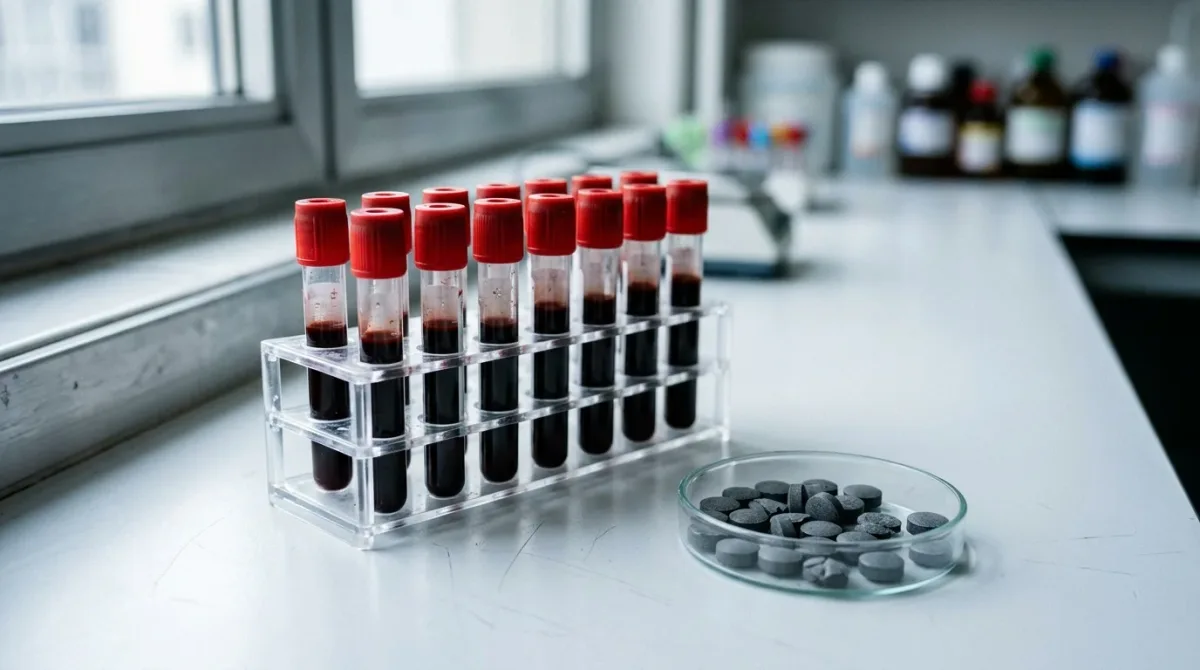
Heavy menstrual periods are one of the most common reasons women in the United States run low on iron: blood carries iron out of the body, and when monthly losses outpace what the diet replaces, iron stores fall first and red blood cells follow. The CDC reports that heavy menstrual bleeding affects more than 10 million American women each year.
What follows is information, not medical advice. Bleeding patterns and iron levels are individual, and only your own clinician can interpret yours. This piece explains the mechanism — how blood loss becomes low iron, in what order, and what the named guidance says about each step.
What counts as heavy menstrual bleeding?
Heavy menstrual bleeding is menstrual blood loss large enough to interfere with everyday life or with the body's iron balance. According to the CDC's 2024 patient information, the usual markers are bleeding that lasts more than seven days, or needing to change a tampon or pad after less than two hours.
The American College of Obstetricians and Gynecologists describes the same picture in its patient guidance, reviewed in 2022: bleeding lasting more than seven days, bleeding that soaks through one or more tampons or pads every hour for several hours in a row, needing to change protection during the night, and clots the size of a quarter or larger.
Two things are worth noting about these thresholds. They are descriptive rather than diagnostic — they are prompts to seek an evaluation, not a diagnosis anyone can make at home. And they are common: the CDC puts heavy menstrual bleeding at roughly one in five women.
How does menstrual blood loss lower iron?
Iron is a component of hemoglobin, the protein in red blood cells that carries oxygen. Blood that leaves the body takes its iron with it, and that iron is not recovered. When the amount lost each cycle exceeds the amount absorbed from food, the body draws down its reserves to keep hemoglobin production going.
The National Institutes of Health Office of Dietary Supplements, in its iron fact sheet updated in September 2025, names women with menorrhagia — abnormally heavy menstrual bleeding — as a group at risk of iron deficiency, and estimates that about 10% of menstruating women bleed heavily enough to qualify.
What makes this mechanism easy to miss is its slowness. A single heavy period rarely empties the reserves. Repeated heavy cycles over months or years can, and because the decline is gradual, the body adapts as it goes and the change is often felt as ordinary tiredness rather than as anything sudden.
Does low iron always mean anemia?
No. Iron deficiency and iron deficiency anemia are different stages of the same process, and a person can be well into the first without meeting the definition of the second. The NIH Office of Dietary Supplements describes the progression in three steps, with hemoglobin — the measure most people think of as "anemia" — falling last.
| Stage | What is happening | What blood tests show |
|---|---|---|
| 1. Storage iron depletion | Reserves are being drawn down | Serum ferritin and bone marrow iron decrease |
| 2. Iron-deficient erythropoiesis | Stores are exhausted; red cell production is starting to be constrained | Transferrin saturation declines; hemoglobin still normal |
| 3. Iron deficiency anemia | Red cells are affected | Hemoglobin and hematocrit decline; cells become microcytic and hypochromic |
Stages are drawn from the NIH Office of Dietary Supplements iron fact sheet, updated September 2025. The practical implication is that a normal hemoglobin result does not by itself rule out depleted iron stores — which is a question for a clinician, not for self-interpretation.
What does low iron feel like?
Often, nothing at first. The National Heart, Lung, and Blood Institute, in its 2022 overview of iron-deficiency anemia, states that mild-to-moderate cases may produce no signs at all, and lists fatigue, dizziness or lightheadedness, cold hands and feet, and pale skin among the symptoms that appear as it becomes more severe.
The NIH Office of Dietary Supplements adds a functional dimension: weakness, fatigue, difficulty concentrating, and impaired cognitive and immune function. These are non-specific — plenty of unrelated conditions produce the same list — which is precisely why the question is settled by testing rather than by symptom-matching.
ACOG notes that severe anemia can cause shortness of breath and increase the risk of heart problems. That is the reason heavy bleeding is treated as worth evaluating rather than waiting out, even when the bleeding itself feels manageable.
How is iron status measured?
Through blood tests ordered and interpreted by a clinician. The NIH Office of Dietary Supplements calls serum ferritin the most efficient test of iron status and notes that a level lower than 30 mcg/L suggests iron deficiency; for hemoglobin, it cites a level lower than 12 g/dL in people aged 10 and older as suggesting iron deficiency anemia.
The National Heart, Lung, and Blood Institute describes the same workup in broader terms: a complete blood count along with measures of hemoglobin, blood iron, and ferritin. Reference ranges vary between laboratories, and a single number is read in the context of the whole picture, including any inflammation, which can raise ferritin independently of iron stores.
None of these thresholds are a self-test. They are included here so the vocabulary on a lab report is recognizable, not so a reader can classify her own result.
Why is the period heavy in the first place?
Because heavy bleeding is a symptom, not a diagnosis, the cause matters as much as the iron. ACOG's patient guidance lists irregular ovulation — including in polycystic ovary syndrome and hypothyroidism — bleeding disorders, certain medications including blood thinners and aspirin, copper IUDs, endometriosis, pelvic inflammatory disease, and pregnancy complications, and states plainly that heavy menstrual bleeding can be an early sign of endometrial cancer.
The CDC's list overlaps and adds specifics on inherited bleeding conditions such as von Willebrand disease and platelet function disorders. It also makes an honest admission that is easy to overlook: for many women with heavy menstrual bleeding, providers may not be able to identify the cause.
ACOG describes the standard evaluation as history-taking, menstrual tracking, a physical exam, and lab work, with imaging such as ultrasound, MRI, or hysteroscopy when indicated. It notes that about one-third of women seek treatment for heavy bleeding.
How much iron do adult women need?
Recommended intakes are set by the Food and Nutrition Board and published by the NIH Office of Dietary Supplements. These are population reference intakes, cited here as facts from that source rather than as anything this publication recommends for any individual — needs during heavy bleeding, pregnancy, or supplementation are a clinical judgment.
| Life stage (female) | Recommended Dietary Allowance |
|---|---|
| 9–13 years | 8 mg |
| 14–18 years | 15 mg |
| 19–50 years | 18 mg |
| 51+ years | 8 mg |
| Pregnancy | 27 mg |
| Lactation | 9–10 mg |
Figures from the NIH Office of Dietary Supplements iron fact sheet, updated September 2025. The jump at 19 and the drop at 51 both track menstruation: the higher figure covers ongoing menstrual losses, and the lower one reflects their end.
What does treatment usually involve?
Two tracks, run in parallel: replacing the iron and addressing the bleeding. For the iron, the National Heart, Lung, and Blood Institute describes oral iron supplements typically taken for three to six months, intravenous iron in severe cases, and treatment of any underlying source of blood loss. Which of these applies, and at what dose, is a decision for a treating clinician.
For the bleeding itself, ACOG's patient guidance describes medications as the usual first step — hormonal birth control, NSAIDs, and tranexamic acid — with surgical options such as endometrial ablation, myomectomy, or hysterectomy considered if medication does not work. The right sequence depends on the cause, on the person's plans for pregnancy, and on preferences that only she can weigh.
When to talk to a clinician
The CDC's guidance is direct: if you have heavy menstrual bleeding, see a healthcare provider. ACOG frames it the same way, encouraging anyone concerned about the amount she is bleeding to talk to her ob-gyn — including if bleeding has changed, or if fatigue has become part of the picture.
Mayo Clinic, in material dated August 2023, names a threshold for prompt care: vaginal bleeding heavy enough to soak at least one pad or tampon an hour for more than two hours in a row warrants contacting a doctor without waiting. Bleeding at that rate is not something to manage at home.
It is also reasonable to raise iron directly. Because ferritin can be low while hemoglobin is still normal, asking what was measured — and what was not — is a fair question at any visit.
For a related women perspective, read Achieving Effortless Chic: The Clean Girl Look Demystified.
For more context, read What to Know About Iron Deficiency.
For more context, read hair loss.
For more context, read Skin cycling isn't a vibe, it's a math problem for your face.